
📖 Introduction – What Does “Empty Pipe Alarm” Really Mean?
At 2:00 AM, the control room phone rings:
“Flowmeter FIC-2301 shows EMPTY PIPE alarm. Flow is zero.
Is the pipeline really empty, or is it an instrument issue?”
This is one of the most common issues with electromagnetic flowmeters.
Many technicians immediately try to reset the alarm on the transmitter.
It disappears… and then comes back again.
👉 Because the root cause was never solved.
This article walks you through a real industrial case, explaining:
- What triggers the empty pipe alarm
- The most common causes
- How to diagnose it quickly
- How to fix it properly (not just reset it)
🎯 Key Principle
Resetting the alarm only clears the symptom.
👉 The real question is:
Is the pipe actually full? If yes, why does the meter think it’s empty?
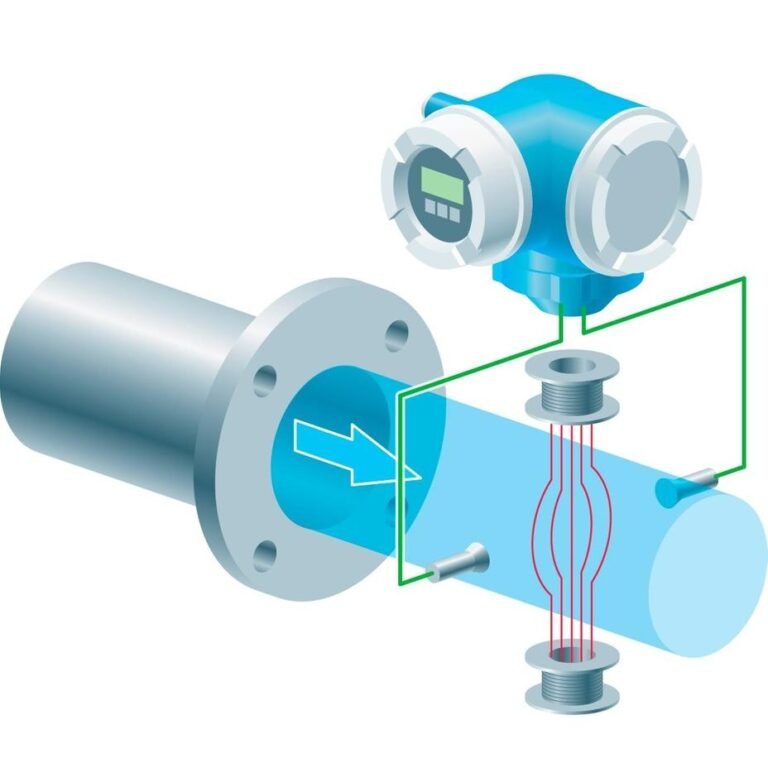
🔬 1. How Empty Pipe Detection Works
Electromagnetic flowmeters operate based on Faraday’s Law of Electromagnetic Induction:
- Conductive liquid flows through a magnetic field
- A voltage is induced (proportional to velocity)
⚠️ Important:
This signal is only valid when the pipe is completely full.
If the pipe is partially empty:
- Signal becomes unstable or disappears
- Output may show random values or zero
👉 That’s why empty pipe detection is built-in
Common Detection Methods
1. Electrode impedance detection (most common)
- Full pipe → low resistance
- Empty pipe → very high resistance
2. Dedicated empty pipe electrode
- Installed at top position
- Detects liquid level directly
⚠️ 2. Top 7 Causes of Empty Pipe Alarm
Before resetting, identify the cause:
1. Pipeline actually empty (most common)
- Pump stopped
- Valve closed
- Startup/shutdown
2. Air bubbles / two-phase flow
- Cavitation
- Low pressure boiling
- Process switching
3. Low conductivity liquid
- Pure water / RO water
- Diluted chemicals
4. Electrode coating / fouling
- Oil, scale, biofilm
- Increases resistance → false alarm
5. Wrong threshold setting
- Too sensitive → false triggering
6. Wiring or electrode failure
- Loose or broken connection
7. Wrong installation position
- Installed at highest point
- Gas accumulation
- Electrodes exposed intermittently
📋 3. Real Case Study (Endress+Hauser Promag)
📌 Background
- Model: Endress+Hauser Promag 50
- Size: DN100
- Medium: Cooling water
Problem:
- Alarm: EMPTY PIPE
- Flow suddenly = 0
- But:
- Pump running
- Pressure normal
- Pipe vibrating
👉 Clearly not a real empty pipe
🔍 Step-by-Step Diagnosis
Step 1 – Process check (5 min)
✔ Pump running
✔ Pressure OK
✔ Flow likely present
Step 2 – Check diagnostics (5 min)
- Alarm: Empty Pipe
- Electrode voltage: 280 mV
👉 Normal should be: 40–80 mV
Step 3 – Analyze root cause (10 min)
Recent change:
- Chemical dosing system adjusted
👉 Conclusion:
- Thin film formed on electrodes
- Resistance increased → false alarm
⚡ Step 4 – Temporary Fix (15 min)
- Adjust empty pipe threshold:
- From 50% → 70%
✔ Alarm cleared
✔ Flow returned to normal (~285 m³/h)
🔧 Final Solution
- Clean electrodes during shutdown
- Restore threshold to default
⚡ 4. How to Reset the Alarm Properly
⚠️ Before Resetting – Check These 3 Questions:
- Is the pipe really full?
- Has process condition changed?
- Any instrument fault?
✅ Method 1 – Auto Reset
If pipe becomes full again → alarm clears automatically
✅ Method 2 – Manual Reset
Typical path:
- E+H: Diagnostics → Reset alarms
- Siemens: Parameter → Reset
- KROHNE: Service → Reset
✅ Method 3 – Adjust Threshold (Temporary)
Used when:
- Slight fouling
- Low conductivity
⚠️ Do NOT set too high
(Otherwise detection becomes useless)
🧹 5. Electrode Cleaning (Root Solution)
When to clean?
- Frequent false alarms
- High electrode voltage
- Dirty / scaling media
Cleaning methods:
Soft fouling:
- Alcohol / acetone wipe
Hard scale:
- 5–10% dilute HCl soak
⚠️ Never:
- Use metal tools
- Use strong acids
- Damage lining
🛡️ 6. How to Prevent It
Installation:
- Avoid highest point
- Install horizontally (electrodes at 3 & 9 o’clock)
Process:
- Avoid air bubbles
- Ensure proper conductivity
Maintenance:
- Periodic cleaning
- Check electrode condition
💡 Engineering Tip (Important)
If your application has:
- Low conductivity
- Frequent bubbles
- Heavy fouling
👉 Electromagnetic flowmeter may not be ideal.
In such cases, consider:
- Coriolis Mass Flow Meter
✔ Not affected by conductivity
✔ Higher accuracy
✔ Better for difficult media
🎯 Final Takeaways
- Empty pipe alarm = safety protection, not just an error
- Always check process first
- Most common causes:
- Real empty pipe
- Air bubbles
- Electrode fouling
👉 Temporary fix: adjust threshold
👉 Permanent fix: solve root cause
📩 Need Help?
If you are facing similar issues:
- Frequent empty pipe alarms
- Unstable readings
- Difficult media conditions
👉 Send me your application details:
- Medium
- Flow range
- Pipe size
- Pressure & temperature
I can help you:
- Diagnose the issue
- Recommend the right solution
- Provide suitable models & pricing